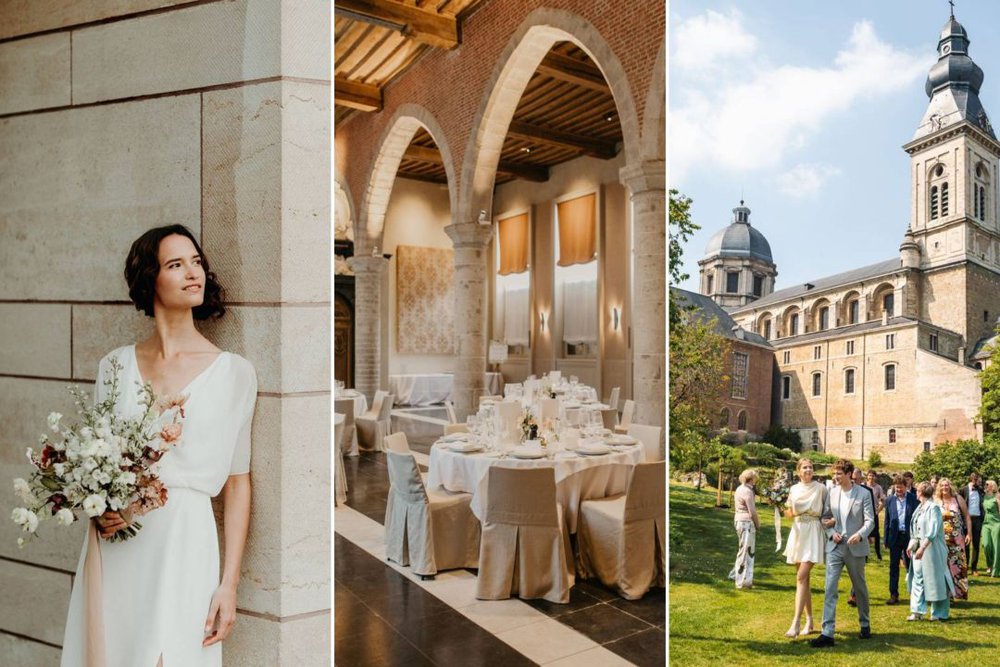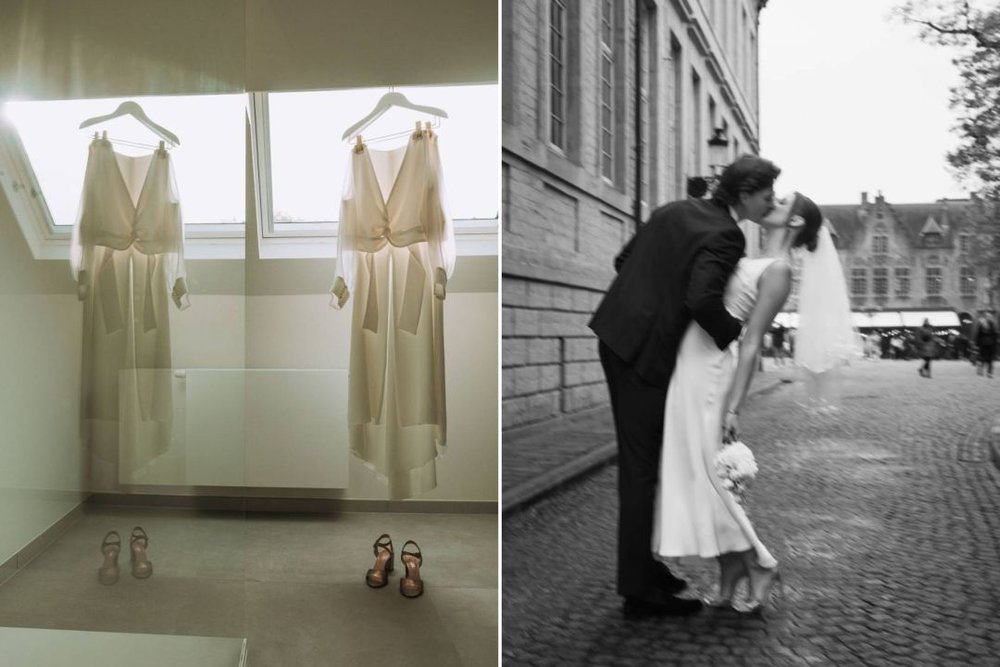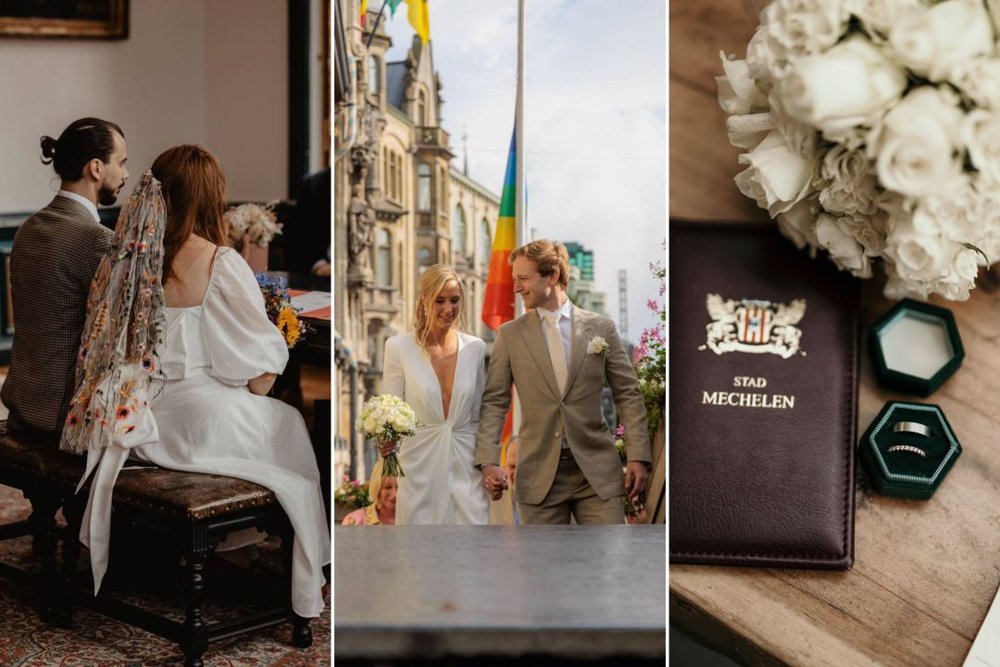
Photo (above): Photographer: PIXEL Creative Studio
1. What is a civil ceremony?
The civil ceremony is the official, legal moment when your marriage is solemnised by a registrar. Only then are you legally married. You can also get married in church and/or organise a separate ceremony and wedding reception, but this legal step is essential if you want to get married in Belgium.
2. When and where do you have your civil wedding?
You choose a wedding date in the Belgian municipality or city where at least one of you lives or officially resides. Many town halls and city halls work with a reservation system and fixed times for weddings, such as Fridays or Saturdays.
Tip: popular wedding dates (in the summer months and on Saturdays) are often booked up quickly. So contact your town hall or city hall early to reserve your date and time! This date does not have to be the same as the date of your wedding reception. Some couples choose to organise their civil wedding and reception on the same day, while others prefer to do so on separate days, for example to have more time on the day of their reception or because they are planning their reception abroad.
3. The marriage declaration: mandatory for getting married in Belgium
Between six months and fourteen days before your desired wedding date, you must submit a marriage declaration to your city or municipality. Check with your municipality in advance to find out what you need to bring to your appointment. In most cases, you will need to bring the following items for your marriage declaration:
- Your identity cards;
- If necessary: the birth certificates of both of you. If you were born in Belgium, the municipality can usually request these itself. If you were born abroad, you must provide an official copy yourself.
- If necessary: proof of nationality, certificate of unmarried status or divorce certificate;
- If necessary: the details of your witnesses.
- After this declaration, your wedding date is officially set. You will receive a certificate of declaration.
4. How does a civil wedding work? All the steps at a glance
The day of your civil ceremony has arrived! Below you can see step by step what to expect when you get married in Belgium.
1. Arrival at the town hall
You arrive at the town hall, together with your witnesses, family and/or friends. Some choose a quiet arrival, others arrive in style – with a vintage car or wedding procession. Don't forget your identity cards and those of your witnesses.
2. Registering with the local authority
You will usually be asked to register at the reception desk or directly at the wedding hall about ten minutes in advance. This lets the registrar know that you are present and ensures that the ceremony can start on time. A local authority employee will check that everything is in order: names, identity details, witnesses, documents, etc. Ask your local authority for details of the exact procedure.
3. Entering the wedding hall
The guests take their seats in the wedding hall. You may sit at the front, together with the witnesses. In some municipalities, your entrance is accompanied by music (either your own choice or standard music provided by the town).
4. The registrar opens the ceremony
The registrar welcomes you and starts with a short introduction. Sometimes this is a personal speech, sometimes it is more formal. The registrar then reads a legally prescribed text about the rights and obligations of married couples according to the Belgian Civil Code.
5. The wedding question
Then comes the moment: the registrar asks each of you whether you want to take each other as lawful spouses. You answer separately with “I do”. This is the official “yes” that counts for the law.
Although it is not a mandatory part of the civil ceremony, many couples choose to exchange rings after saying “I do”. Discuss this with your local council in advance – in most cases, it is perfectly possible. The first kiss as newlyweds is also not a mandatory part of the ceremony, but in most councils it is done spontaneously.
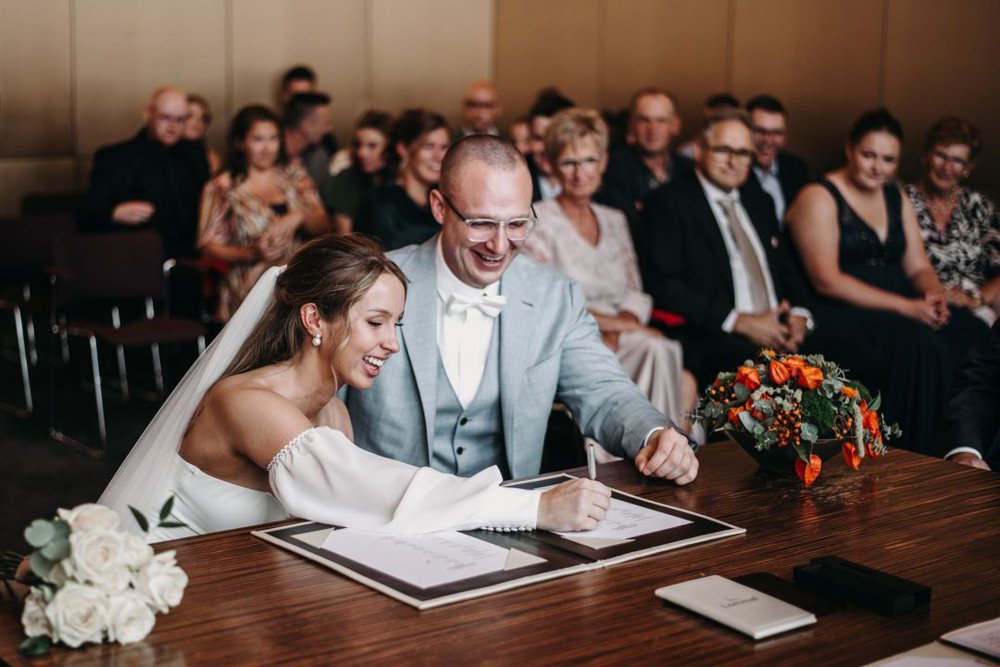
6. Signing the marriage certificate
After saying ‘I do’, you will sign the official marriage certificate. The witnesses will also sign, as will the registrar. This makes the marriage legally valid.
7. Presentation of the marriage certificate
You will receive the marriage certificate or a copy of the marriage certificate. This certificate will be used later for official changes such as a change of address or the birth of children.
8. Closing and congratulations
The registrar closes the ceremony, often with a personal wish or closing words. Sometimes you can have a drink afterwards (e.g. a glass of champagne or fruit juice offered by the city), and there is usually time to take some photos inside and outside the town hall.
The entire ceremony lasts between 10 and 30 minutes on average.
5. Can you add a personal touch to your civil wedding?
Yes, absolutely! More and more municipalities are allowing for a warm, personal atmosphere. Be sure to have this ceremony captured by your photographer and videographer. You can often:
- Bring your own music (via USB or Spotify link);
- Have a personal speech read aloud (by yourself or by the registrar, to be provided in advance);
- Decorate the room with flowers or other details (depending on the regulations);
- Some municipalities also provide a glass of champagne or fruit juice afterwards. Check this with your municipality in advance.
- You can add a more extensive, very personal touch to your separate ceremony, which you can organise entirely according to your wishes and where all your speakers and complete decorations will have a place.
6. How much does a civil wedding cost?
In many municipalities, getting married in Belgium is free on a weekday during office hours. If you opt for a ceremony on Friday evening or Saturday, a location outside the town hall or extras such as music, decorations or a reception, you will usually pay a surcharge. The price varies from municipality to municipality, but on average it is between €50 and €300. Be sure to check with your municipality or city for the exact rates and options.
Would you like to hire someone to ensure that your civil wedding, ceremony and other moments run smoothly? Then choose a master of ceremonies, who will help you get every detail right.
Find and book your master of ceremonies here
Read more about this topic via these links:
Your wedding ceremony in 5 steps
The difference between a wedding planner, master of ceremonies and ceremony speaker